


I want to highlight two articles from the past month. Both were written by Jewish journalists, one a leftist Israeli, Orly Noy, the other a conservative American, Bret Stephens.
The first is from the small, independent media organization +972, which describes itself as follows:
+972 Magazine is an independent, online, nonprofit magazine run by a group of Palestinian and Israeli journalists. Founded in 2010, our mission is to provide in-depth reporting, analysis, and opinions from the ground in Israel-Palestine. The name of the site is derived from the telephone country code that can be used to dial throughout Israel-Palestine.
The article is by Orly Noy, who spoke to one of my groups a number of years ago. She was amazing. Here’s how +972 describes Noy.
Orly Noy is an editor at Local Call, a political activist, and a translator of Farsi poetry and prose. She is the chair of B’Tselem’s executive board and an activist with the Balad political party. Her writing deals with the lines that intersect and define her identity as Mizrahi, a female leftist, a woman, a temporary migrant living inside a perpetual immigrant, and the constant dialogue between them.
Noy wrote this article about a month ago, so before the recent ceasefire.
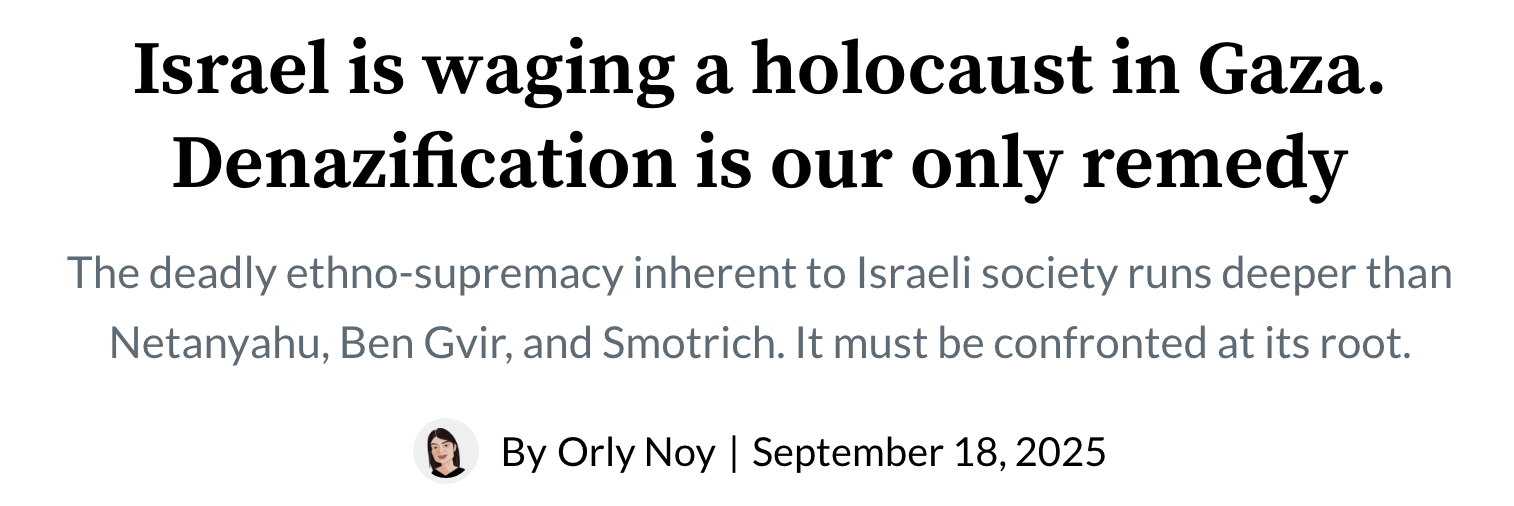
Here is her main point.
Over the past 23 months, Israeli society has spun an endless web of lies to justify and enable Gaza’s destruction — not only to the world, but above all to itself. Chief among them is the claim that hostages can only be freed through military pressure. Yet those carrying out the army’s orders, raining mass death upon Gaza, do so knowing full well they may be killing the hostages in the process. The indiscriminate bombing of hospitals, schools, and residential neighborhoods, coupled with this disregard for the lives of Israelis held captive, proves the war’s true aim: the sweeping annihilation of Gaza’s civilian population.
Israel is unleashing a holocaust in Gaza, and it cannot be dismissed as the will of the country’s current fascist leaders alone. This horror runs deeper than Netanyahu, Ben Gvir, and Smotrich. What we are witnessing is the final stage in the nazification of Israeli society.
The urgent task now is to bring this holocaust to an end. But stopping it is only the first step. If Israeli society is ever to return to the fold of humanity, it must undergo a deep process of denazification.
Once the dust of death settles, we will have to retrace our steps back to the Nakba, to the mass expulsions, the massacres, the land seizures, the racial laws, and the ideology of inherent supremacy that normalized contempt for the native people of this land, and the theft of their lives, property, dignity, and the futures of their children. Only by confronting this deadly mechanism inherent to our society can we begin to uproot it.
The other article I want to highlight was written by Bret Stephens, who describes himself in this way.
My hometown is Mexico City. I studied political philosophy at the University of Chicago and comparative politics at the London School of Economics. I worked for The Wall Street Journal in Brussels, where I mainly covered European topics, and was editor in chief of The Jerusalem Post, where I covered Middle Eastern ones. For many years I was The Journal’s foreign-affairs columnist, for which I won the 2013 Pulitzer Prize for commentary. I’m the author of “America in Retreat: The New Isolationism and the Coming Global Disorder.” In 2022, the government of Russia barred me for life.
Stephens published this piece on October 14.
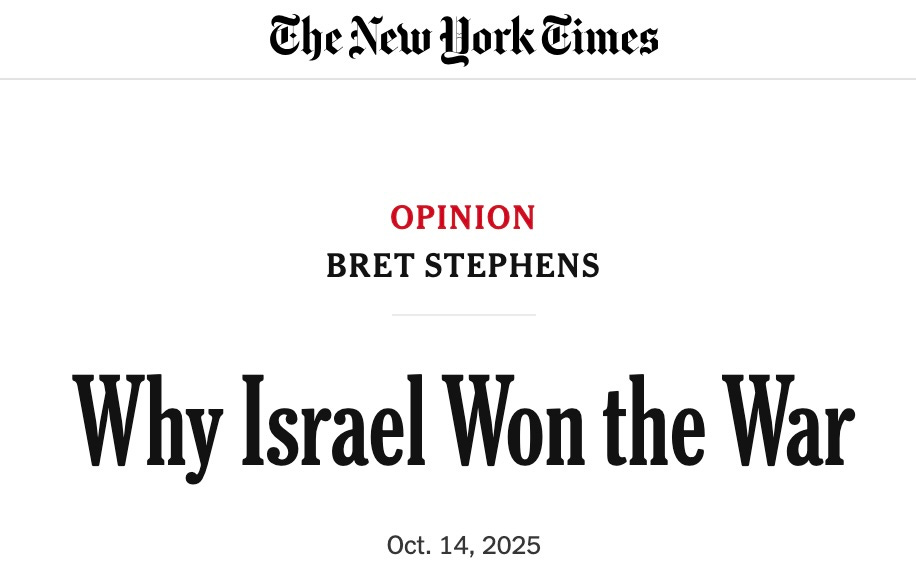
And here is his main point.
Note: Yahya Sinwar was the leader of Hamas and the architect of the October 7 attacks in Israel. He was killed in Gaza almost one year ago, on Oct 16, 2024.
But they [Jewish Israeli soldiers] came from nearly every political quarter to fight not out of ideological or partisan conviction, but because Sinwar’s aims and methods on Oct. 7 made clear that the stakes were existential. What’s more, the gleeful support those aims and methods instantly engendered worldwide made clear that, even now, there’s still no safe harbor for Jews. Not Australia. Not Canada. Not Britain. Not France. Not Germany. And perhaps not America.
Do earnest progressives really think that if the Jewish state were to vanish tomorrow, to be replaced by some utopian binational state, the anti-Jewish furies in the Middle East, Europe or North America would somehow abate? Or would those furies simply find easier targets?
Nor did Israelis fight only because they were faced by an existential threat. They also faced an existential lie: the lie that Israel is a settler-colonialist state, a nonnative invasive species that has no place in that land. It’s a lie that’s taken hold everywhere, even if a 3,000-year historical record disproves it. And it’s a lie that, as it’s grown bolder, attacks the very roots of Jewish identity. “If I forget thee, O Jerusalem …” wasn’t simply meant as literary metaphor. To prove the point, Israelis had to fight and win the war.
The current cease-fire brings a set of difficult questions about what comes next — for Israelis and Palestinians and everyone else invested in their future. But it should settle important questions, too. Are Israelis weak? Is their state built on foundations of sand? Is their attachment to their beliefs slight?
Yahya Sinwar and those who followed him thought so. The grave he made for himself should settle the questions for good.
These are two very different narratives. And the difference between them has been and will continue to be a matter of life and death for Palestinians, mainly, but also for Israelis.
I’ll be back tomorrow with some thoughts on these two narratives.