


Next gathering: “Life After Religion,” with Daryl and Sara Van Tongeren, May 14, 7pm, Port 393, Holland
Friedrich Nietzsche and the Death of God
For the longest time, I misunderstood philosopher Friedrich Nietzsche’s proclamation, “God is dead. God remains dead. And we have killed him.” Because I was swimming in Christian circles, I learned that Nietzsche was just an arrogant atheist who thought religion was stupid. That’s a little bit right, to be fair. But it’s not the main point of Nietzsche’s analysis.
Nietzsche was born at the end of the Enlightenment, which came on the heels of the Scientific Revolution. This is from Google Gemini:
The Scientific Revolution was a period of drastic change in scientific thought and understanding that took place in Europe during the 16th and 17th centuries. It marked a fundamental shift from relying on ancient Greek and Roman traditions toward a worldview based on empirical observation, mathematical modeling, and the scientific method.
And here is a summation of the Enlightenment from Google Gemini:
The Enlightenment, also known as the Age of Reason, was an intellectual and cultural movement that flourished in Europe and the Americas during the late 17th and 18th centuries. It was defined by an emphasis on reason, science, and skepticism over tradition, superstition, and religious dogma.
The authority of the Bible and Christianity had been dramatically weakened.
Nietzsche writes the “Parable of the Madman” in 1882, in which the madmen says these famous lines: “God is dead. God remains dead. And we have killed him.” We killed God through our search for knowledge, truth, and goodness, desires which were ironically kindled in us by Christianity. But our search for truth was not confirming the worldview of the Bible, but undermining it. This problem has only deepened.
Though Nietzsche celebrated our liberation from Christianity, in the Parable of the Madman, Nietzsche is warning intellectuals that the death of God will be highly disruptive. The madman appears in the market and pretends to be looking for God. He is mocked by those who have understand and appreciate the insights of the Enlightenment.
Have you not heard of that madman who lit a lantern in the bright morning hours, ran to the market place, and cried incessantly: “I seek God! I seek God!”—As many of those who did not believe in God were standing around just then, he provoked much laughter. “Has he got lost?” asked one. “Did he lose his way like a child?” asked another. “Or is he hiding? Is he afraid of us? Has he gone on a voyage? emigrated?”—Thus they yelled and laughed
The madman is speaking to intellectuals who have learned the insights of the last few hundred years and understand that the God of Christianity is false. Nietzsche also believes this, but he worries that others are underestimating the magnitude of the loss of religion. How will people cope?
“Is not the greatness of this deed too great for us? Must we ourselves not become gods simply to appear worthy of it? There has never been a greater deed; and whoever is born after us—for the sake of this deed he will belong to a higher history than all history hitherto.”
For so many people, everything rests on the truth of Christian belief, including much of the morality upon which societies function. This was still the case when Nietzsche was writing. Since then, Christianity has lost many of its adherents and much of its social capital in Europe. In the United States, we are decades behind.
The Death of God arrives in the USA
Near the end of the Parable of the Madmen, the madmen says this to those who mock religious belief.
“I have come too early,” he said then; “my time is not yet. This tremendous event is still on its way, still wandering; it has not yet reached the ears of men. Lightning and thunder require time; the light of the stars requires time; deeds, though done, still require time to be seen and heard. This deed is still more distant from them than most distant stars—and yet they have done it themselves.”
Nietzsche writes this in 1882; he had indeed “come too early.” But the death of God did indeed come to Europe, and has now come to the USA.
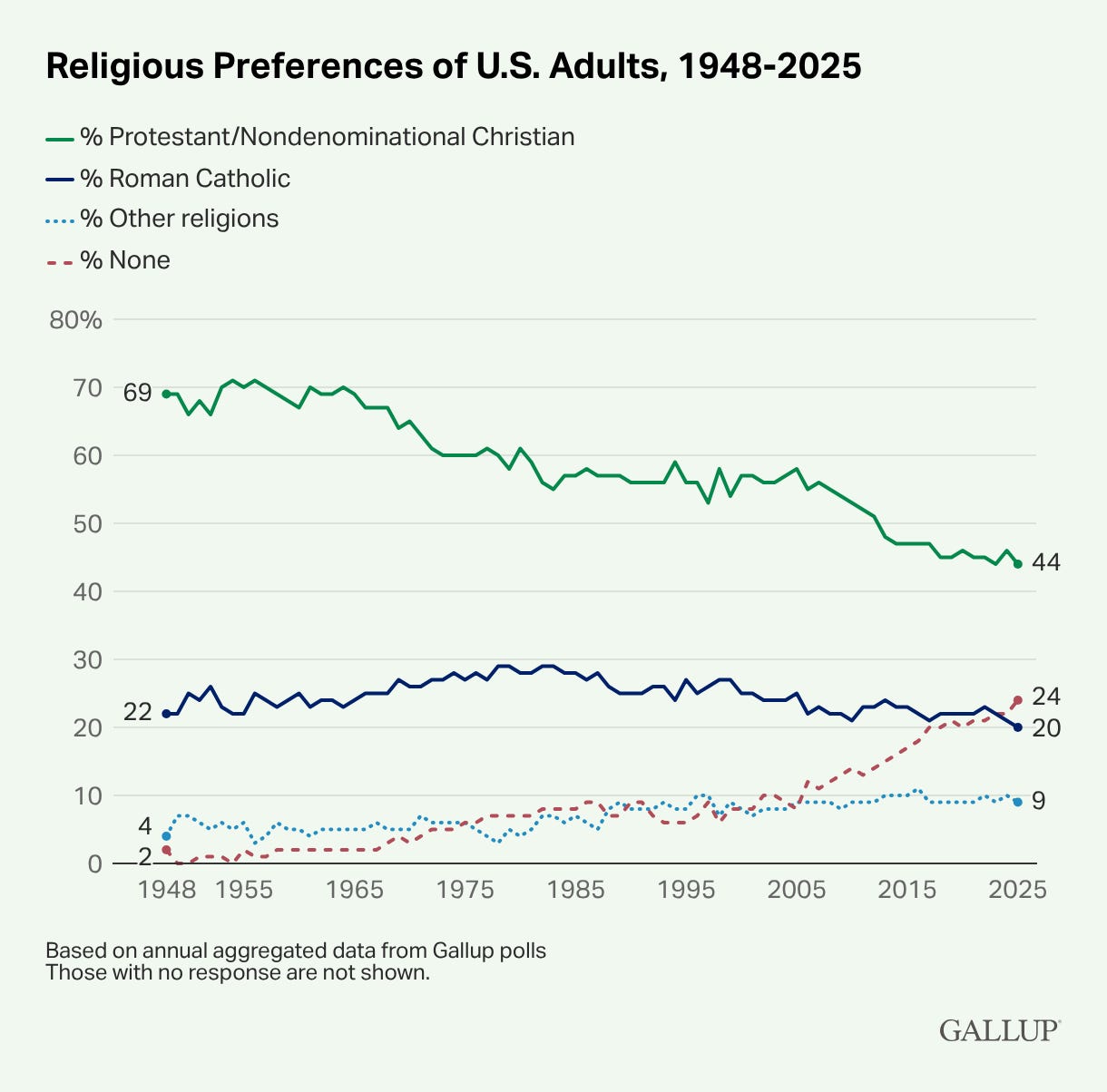
In 2000, 8% of U.S. adults identified as Nones (No religion). In 2025, Gallup puts the percentage of Nones at 24%. Ryan Burge, who studies religious trends in the U.S. puts the number of Nones at about 32%.
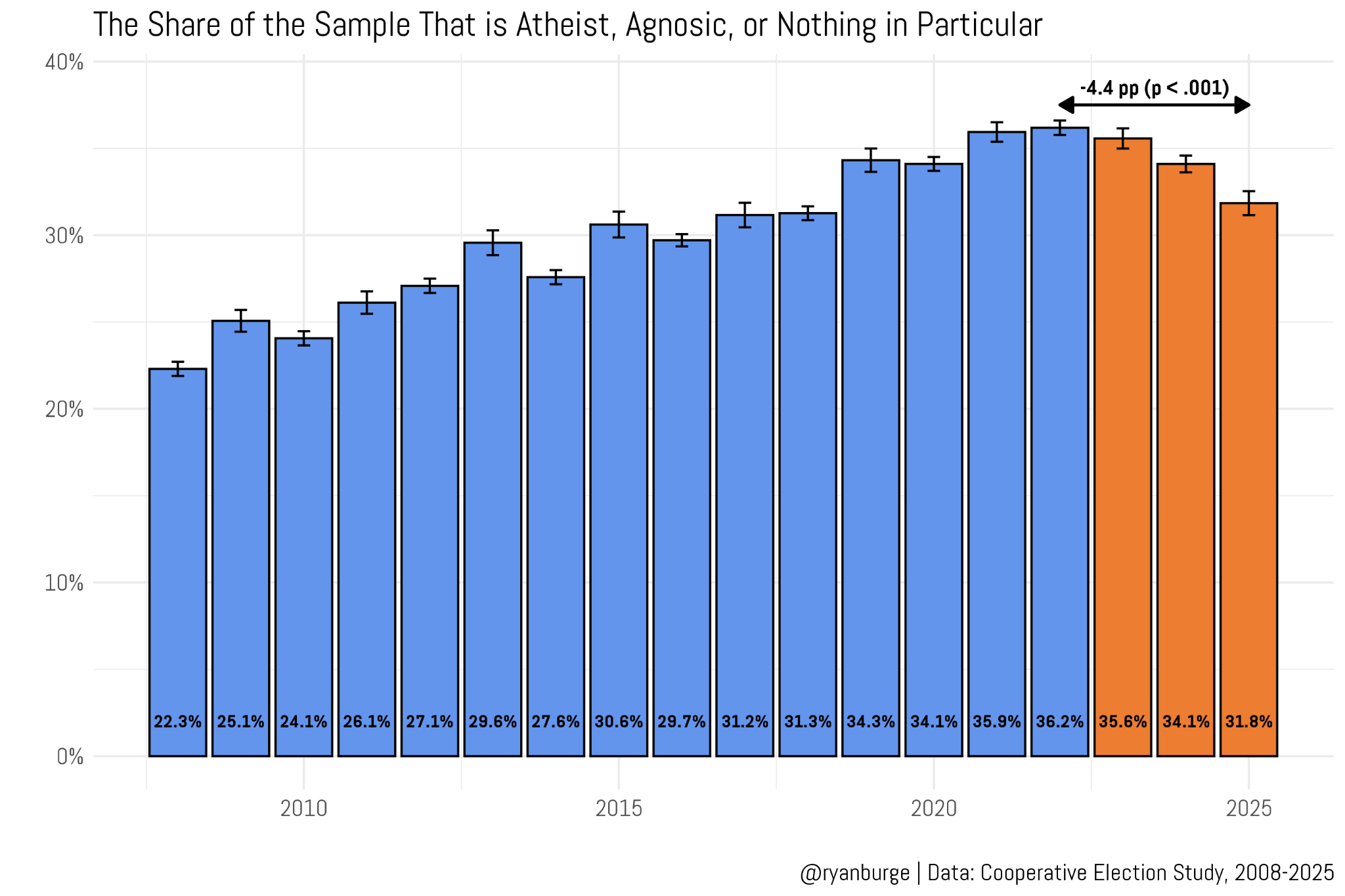
As you can see, the share of Nones appears to have leveled off over the last five years. But here’s the thing, The Silent Generation and the Boomers are the most religious generations. In the next 25 years, those in the Silent Generation will be gone and the number of Boomers will be cut in half.
The generations behind the Boomers (X, Millennial, and Z) are neither big enough nor devout enough to make up for the loss of the Boomers.
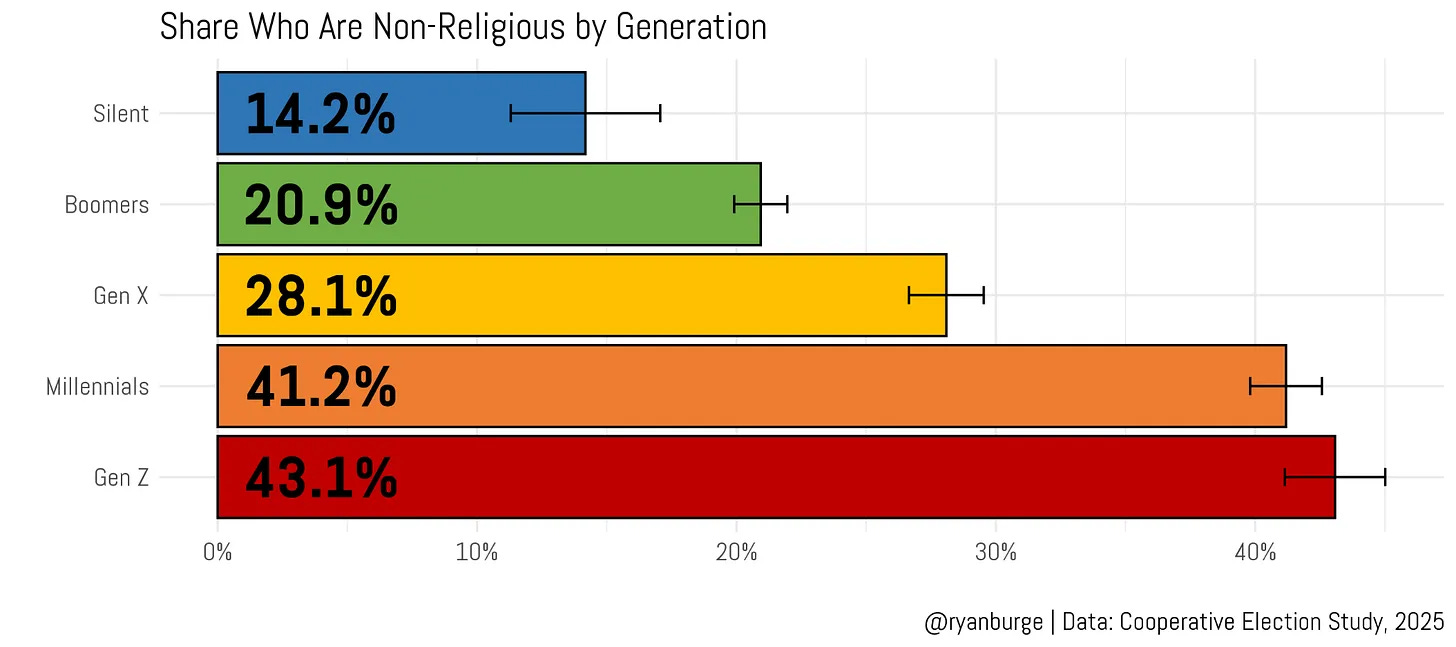
Ryan Burge, professor of practice at the Danforth Center on Religion and Politics at Washington University, sums up the next few decades in this way.
So here’s where we land. In the next twenty years, a very large and reasonably devout generation will die. Behind them are generations that are smaller and considerably less religious. The pews will empty. The offering plates will get lighter. Short of genuine religious revival at a scale this country has never seen, this is a statistical inevitability — and the data has been telling us so for years.
We have some tough decades ahead of us.
Ahhhh! But there is that still small voice...that mustard seed of faith...always present for anyone seeking.
Thanks, Josh. This is fascinating and helpful information in light of the perspective from “Nietzsche and the Death of God.” I could not help but notice that “Other Religions” and “Roman Catholics” grew a bit during this time. Simplistically, perhaps, it seems like the “Nones” gained ground exclusively at the expense of “Protestant/Non-denominational” religions. What do you think that means? How is that so? Another thought, considering your final statement about tough decades ahead, is their anything(s) you might opine those of us who would like to stem the tide might be doing, saying, or at least thinking about? Perhaps you could speak with your May 14 guests about a question like this: Is there space for dialogue between those who have or are moving beyond religion and those who are choosing to stay but are moving beyond or away from what some might call “Orthodoxy?” If so, what might that space look like? I am absolutely NOT suggesting a debate forum. There is no way that would be helpful, in my opinion. Debates are about winners and losers.
Again, as always, thanks for sharing your thoughts.